88.7%
Sector occupancy (Knight Frank)
Commercial mortgages, development, bridging, refinance and going-concern operator finance for care homes in Newark. This is finance for the home as a business, not help with care fees.

Care home finance in Newark is the funding used to buy, build, refinance or operate a care home as a trading business. We arrange it across Nottinghamshire for operators, buyers, investors and developers, structuring the debt a home needs and placing it with the lenders that actually back the sector. This is commercial lending against the home and its operator, not help with paying care fees.
A Newark home is assessed as a going concern: its operator, registration, occupancy and the balance of private, self-funded and local-authority fees. Average weekly fees in the East Midlands run at about £1,150/wk (Knight Frank, 2025), and national occupancy held at 88.7% (Knight Frank, FY2024/25), the backdrop a lender reads when sizing a facility here.
We arrange the full range of care home finance for Newark operators and buyers. A commercial mortgage funds the purchase of a trading home, typically to 70 to 75 percent of value over a 15 to 25 year term, with the loan sized on the home's stabilised trading profit. Development finance funds a ground-up build, extension or conversion, usually to 60 to 70 percent of cost. Bridging moves at auction or pre-CQC pace. Refinance lowers a rate, raises capital or exits a bridge. Going-concern operator finance is sized on EBITDARM and the going-concern value rather than the property alone, and sale-and-leaseback releases capital from a freehold while the operator keeps running the home. We match each case to the lenders that back this kind of home across Nottinghamshire.
Each care setting is registered, run and underwritten differently, and we arrange finance for all of them in Newark and across Nottinghamshire. That covers elderly residential and nursing homes, dementia and memory care, specialist and high-acuity care, supported living, learning disability and mental health settings, children's homes, and retirement and extra-care schemes. A nursing home turns on clinical staffing and acuity. A children's home turns on Ofsted standing and local-authority commissioning. Knowing which lender backs which setting here, and at what leverage, is the work we do before a case ever reaches a credit committee. Local planning records show recent care-related activity in the Newark area, a read on demand for modern bed stock locally.
A care home is bought as a trading business, so the return comes from operating profit, not rental yield alone. Mature homes nationally ran at 88.7% occupancy (Knight Frank, FY2024/25), and average weekly fees in the East Midlands sat at about £1,150/wk (Knight Frank, 2025), the two levers that drive the bottom line. Investors size the deal on EBITDARM, the earnings measure lenders use, and on the going-concern value a specialist healthcare valuer puts on the home. Prime care home yields have sat around 4.5% (Knight Frank, Q1 2025), with operational and regional homes priced higher to reflect trading risk. In Newark the figure that matters is the individual home's profit, its CQC rating and how full it runs.
Before you buy a care home in Newark, the checks that matter are the CQC rating and inspection history, the staffing model and agency reliance, the fee mix between private, self-funded and local-authority residents, the property condition and any en-suite or single-room shortfall, and the trading accounts behind the asking price. We pressure-test these as part of arranging the finance, because the same things a buyer should worry about are the things a lender underwrites.
Mid-range fees with an older average resident profile and a solid private-pay share. A steady market where demographics support long-run bed demand. Average weekly fees in the East Midlands run at about £1,150/wk (Knight Frank, 2025). Lenders read these regional fee and occupancy trends, alongside the home's own trading record, when they size a facility for a Newark home.
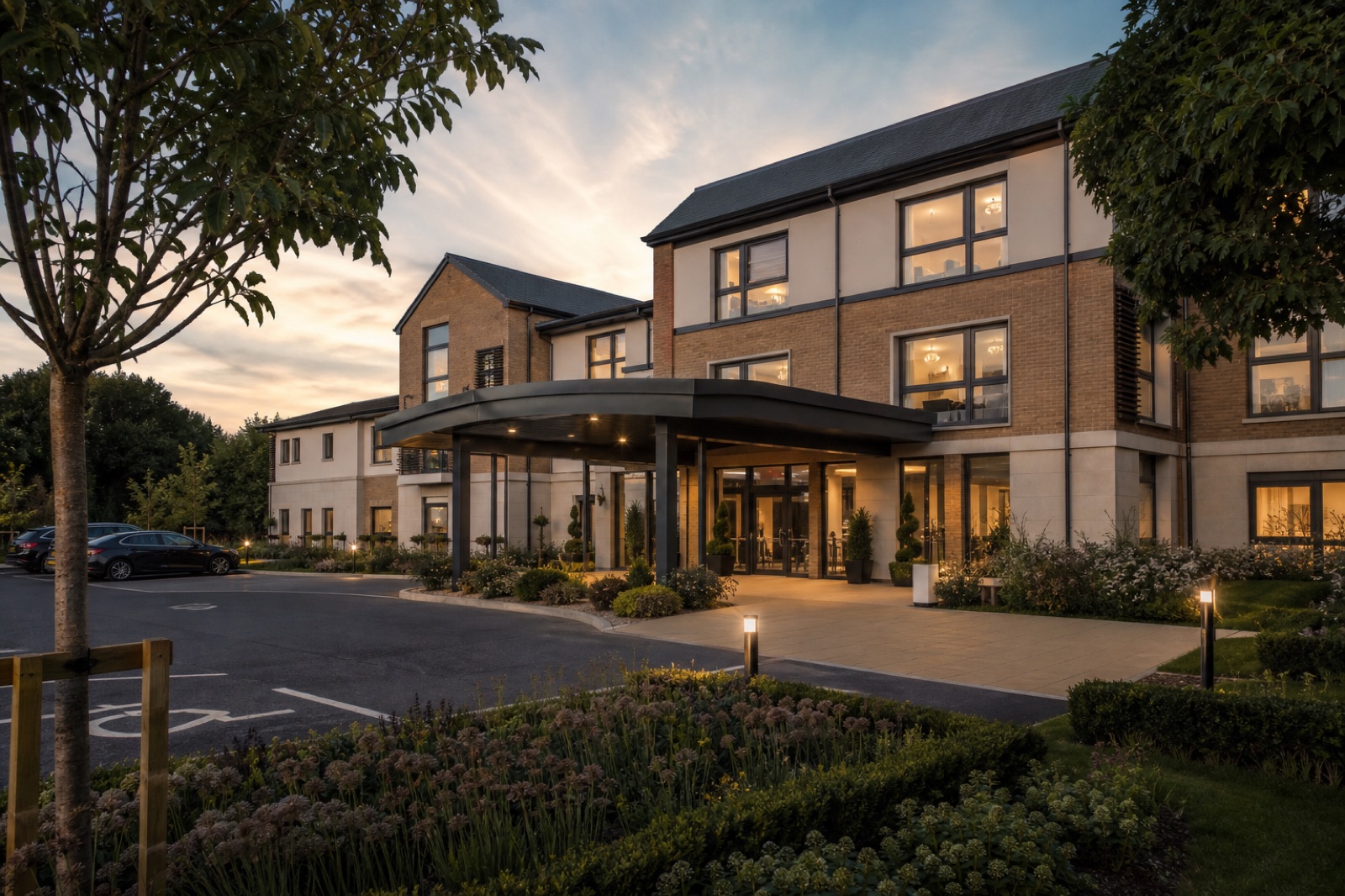
CQC registers 42 care homes in Newark with about 1,261 beds between them, of which 11 hold a nursing registration. Around 88% of rated homes here are rated Good or Outstanding, which makes Newark a deep, well-supplied local care market. For a buyer or operator this is the competitive set, the bed stock and the quality benchmark a new acquisition is underwritten against; for a lender the local rating profile is a read on covenant and on how hard occupancy is won.
Showing the 25 largest of 42 registered homes by bed count.
Source: Care Quality Commission care directory, 03 June 2026. Contains public sector information licensed under the Open Government Licence v3.0. Registration and bed data, not a recommendation of any individual home.
Local house prices are a useful proxy for the strength of the self-funder catchment a care home draws on. Newark recorded around 1,532 residential sales over the past year at a median of £225,850, which makes the local market steady. A deeper, higher-value residential market tends to support a larger private and self-funded fee base, one input among the operator covenant, CQC rating and occupancy that drive a lending decision.
This residential data is local catchment context. It is not a care home valuation, which turns on the home's trading profit and going-concern value, assessed by a specialist healthcare valuer.
| Detached | £325,000 |
| Semi-detached | £192,000 |
| Terraced | £160,000 |
| Flat / apartment | £116,000 |
Source: HM Land Registry residential price-paid data, last 12 months. Local catchment context, not a care home valuation.
| Quarter | Median | Sales |
|---|---|---|
| 2024-Q3 | £230k | 601 |
| 2024-Q4 | £238k | 709 |
| 2025-Q1 | £225k | 685 |
| 2025-Q2 | £232k | 501 |
| 2025-Q3 | £227k | 577 |
| 2025-Q4 | £229k | 542 |
| 2026-Q1 | £230k | 333 |
| 2026-Q2 | £213k | 120 |
Recent care-related planning activity recorded by Newark and Sherwood District Council, a read on local demand for modern bed stock.
Application to Vary Condition 2 (Schedule of Plans) attached to Planning Permission 25/00708/FUL.
View on the planning portal →Most lenders fund up to 70 to 75 percent of value on a trading care home, with the loan sized on the home's stabilised trading profit (EBITDARM) rather than the bricks alone. Leverage reflects the operator covenant, the CQC rating, occupancy and the fee mix. We hold more than one hundred lender relationships and shortlist the desks most likely to back a Newark home.
We work across high-street and challenger banks, specialist healthcare lenders and debt funds, including names such as Shawbrook, OakNorth, Allica Bank and Assetz Capital. The right lender for a Newark home depends on the setting, the operator's track record and the leverage you need, and we match the case to the desks that actively back it across Nottinghamshire.
Care figures are reported regionally rather than town by town. In the East Midlands, the average weekly fee runs at about £1,150/wk (Knight Frank, 2025), while occupancy across mature homes nationally held at 88.7% (Knight Frank, FY2024/25). We read these regional and national figures alongside the individual home's trading record.
Most buyers need a deposit of 25 to 30 percent of the price plus costs, since lenders fund 70 to 75 percent of value on a trading home. On top of the deposit you need working capital to run the home from day one and a contingency for any CQC or property works. The exact figure depends on the home's trading profit and your experience as an operator, which we assess before approaching lenders.
It can be, but profit turns on occupancy, the fee mix and staffing cost, not on the building. Well-run homes with strong CQC ratings and a healthy private-fee share trade profitably; homes with low occupancy, heavy agency use or fee pressure do not. We read the trading accounts and the operator before forming a view, and a lender does the same.
The main warning signs are a poor or declining CQC rating, low or falling occupancy, heavy reliance on agency staff, a fee base skewed to lower local-authority rates, deferred building maintenance and a shortage of single en-suite rooms. None is necessarily fatal, but each affects value and fundability, which is why we and the lender scrutinise them.
No. We arrange care home finance across the whole of Nottinghamshire and the wider UK, with the same approach: read the home and the operator, match the case to the lenders that back the setting, and negotiate terms on the borrower's behalf.
The nearest towns we cover, each with its own registered care home directory and market context.
Send us the home and the operator and we will come back with a view on fundability and likely terms within one working day.